
When Soccer Lineups Come Out, Do the Odds Move Right Away?
A study of “full starting lineup announcements”: about 1 hour before kick-off, both teams name their 11 starters. How do the odds on Polymarket change after that, and for how long? (The second stop of our starting-lineup research.)
Study details
On this page
Key findings
“About 60%” means 59% (range 43%–78%) of the total move from 5 minutes before the announcement to 2 minutes before kick-off—not a 60% change in the odds. Example: if the odds fall from 2.000 to 1.972 by kick-off, they are already about 1.983 fifteen minutes after the announcement. The announcement time is the league’s rule time, 75 minutes before kick-off, not measured match by match; 164 Premier League matches with surprise lineups in 2025-26.
- Teams with weaker-than-expected lineups get higher odds (less favored) and their opponents lower odds. Across 851 surprise lineups, the implied win chance of the team that benefits rose 0.40 percentage point on average in the 30 minutes around the announcement.
- The bigger the surprise, the bigger the move: in the most surprising third of matches, about 0.74 percentage point on average.
- Whether odds move before the announcement (about 0.04 point) or keep drifting after it (about 0.07 point) cannot be confirmed yet.
- Both Polymarket and Pinnacle move around the announcement, with no clear leader (231 matches in 2026-27, exploratory).
In plain words
What do we want to know?
If a team’s main striker doesn’t start and only sits on the bench, the team’s chance of winning may drop. We want to know: once the lineups come out, do the odds on Polymarket change right away, or slowly over time? And do the odds move before the lineups are announced?
How do we study it?
Polymarket is a prediction platform where people buy and sell shares in game results. The price is between $0 and $1; a price of $0.60 roughly means the people trading think, as a group, that this side has about a 60% chance to win (the crowd’s view, not necessarily the true chance). A Polymarket price converts directly to odds: a price of $0.60 means about a 60% win chance and odds of about 1.67 (odds = 1 ÷ price). We use odds recorded every minute for about 1,958 games in the 2025-26 season of the Premier League, La Liga, Serie A, Bundesliga, Ligue 1 and the Champions League, and look at how the odds change before and after the lineups are announced. The Premier League requires lineups to be announced 75 minutes before kick-off, so its timing is the most exact. “Surprise lineups” — such as a key player not starting, or an unexpected player starting — are what we mainly watch.
What is a surprising lineup?
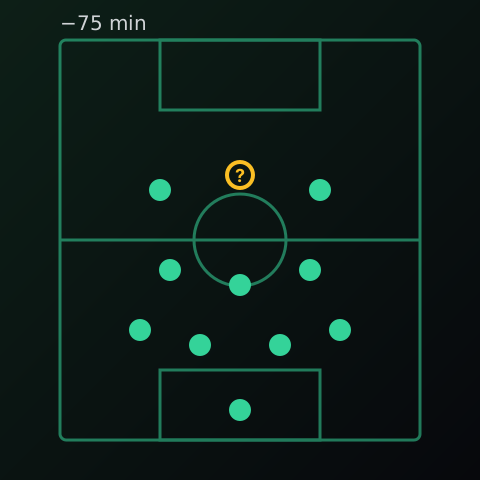
- 01Expected lineup
Illustration: pre-game information suggests regular forward A will start.
- 02Announced lineup
Illustration: A is absent from the starting lineup and reserve forward B starts instead. Other positions are unchanged.
- 03Identify the surprise
Compare expected and announced players; do not automatically assume a substitute is worse.
- 04Compare the odds
Check how the odds change around the announcement.
A and B are fictional placeholders, not actual players or games. This explains the method; see Key findings above for the results.
What have we found?
After Premier League lineups are announced, the odds react quickly: about 60% of the move happens within 15 minutes and half within about 9 minutes, with the rest drifting in before kick-off. The size is small: across 851 surprise lineups, the implied win chance of the team that benefits rose 0.40 percentage point in the 30 minutes around the announcement. Whether odds move before, or keep drifting after, is not yet clear.
How does this help with predictions?
Lineup news is mostly priced in quickly, so a model should update right after lineups are out—or predict the starters better beforehand. Compared with NBA injury news (R1, fast) and NHL goalie confirmations (R4, slow), football lineups fall in between.
What can’t we say yet?
Apart from the Premier League, the other leagues don’t set an exact announcement time, so we can only use the window of “about 80 to 50 minutes before kick-off.” Neither the lineup data nor the odds are official second-by-second records. The results are averages over many games and don’t mean every game is the same.
Terms used on this page
- Polymarket
- A prediction platform where people buy and sell shares in game results. Prices run from $0 to $1 and roughly show the chance the traders think an outcome has — not necessarily the true chance. A price converts directly to odds: odds = 1 ÷ price.
- Starting lineup
- The 11 players on the field when the game starts, plus the list of substitutes.
- Surprise lineup
- A lineup different from the starters expected from pre-game information — for example, a key player doesn’t start, or an unexpected player starts.
- Percentage point
- The gap between two percentages. For example, going from 50% to 51% is a rise of 1 percentage point.
Detailed results
Cumulative change in implied win chance after Premier League lineup announcements
164 Premier League matches with surprise lineups, measured from 5 minutes before the announcement (taken as the rule time, 75 minutes before kick-off; not measured match by match). Unit: percentage points; brackets show the share of the total move.
Pre-registered main description | Premier League 2025-26 | Polymarket minute-by-minute odds converted to win chance | Odds after kick-off reflect the game, so we stop 2 minutes before.
HypothesesFor deeper reading
- H1After the lineup is announced, odds keep moving or pull back → about 0.07 point more; not enough evidenceInsufficient evidence
- H2Around the announcement, odds move the way the news implies → supported: 0.40 percentage point on average (851 matches)Supported in this sample
- H3Before the official announcement, odds already move the way the news implies → about 0.04 point; not clear after correcting for multiple testsInsufficient evidence
- H4Thinner markets keep moving more after the announcement → not seen (opposite direction, unclear); volume is the final total after the matchInsufficient evidence
Background and why it matters
The starting lineup is one of the most important pieces of news before a game, and the league sets when it comes out. Using the same method as R1 (NBA injuries) and R4 (NHL goalies) shows whether the odds react to lineup news the same way in every sport. The results also tell the model at what point lineup information should go in.
Latest progress
Latest:Main results are in and corrected after external code review; all four data checkpoints passed
Next step:Publish after confirming data licensing; re-check on new 2026-27 matches
Study timeline
- Research direction set and novelty checked2026-10-20
- Plan finalized and timestamped2026-10-21
- Odds collected, lineups and events built; four checkpoints passed2026-10-21
- Main analysis done; corrected after external code review2026-10-21
- Publish after confirming data licensingIn progress
- Check again on new games
Methods
What we want to know
- Once the lineups come out, do the odds change all at once, or slowly?
- About how long do the odds take to finish half of their change after the announcement?
- Do the odds already start moving before the lineups are officially announced?
- Are games with less trading more likely to lag?
Method summary
- For every game, the odds are taken at fixed times: 140, 80, 50 and 2 minutes before kick-off. After the lineups are announced, we always look at 48 minutes, so the timing isn’t miscalculated or cut short by kick-off.
- We mainly look only at “surprise lineups.” Games where the lineup matches what was expected are used for comparison: “do the odds change on their own when there is no new news?”
Data and limitations
Data we use
- Polymarket odds for single games in the 2025-26 big five leagues and the Champions League (one reading per minute)
- Pinnacle odds every minute (for comparison, 2026-27 season)
- Starting lineups and injury data (Mysports soccer database)
Limitations
- Only the Premier League has a fixed announcement time, and we use that rule time rather than measuring each match; other leagues use fixed windows.
- “Expected starters” are estimated by a rule; the market also sees press conferences and predicted lineups, so some “surprises” may already be partly known.
- Volume is the final total after the match—there are no pre-match snapshots—so the volume threshold and H4 groups use final volume.
- Lineup and injury data come from a paid provider and Pinnacle odds were collected by us; this page shows aggregated figures only.
Update log
Version history
- v1.0-results2026-10-21
Main results; all 13 external review comments handled (one code bug fixed; main results unchanged)
- v1.02026-10-21
Study plan finalized and timestamped
Study record
b07f1cdcdbf164e6ecd791c117ac27449ca3282df62e6fb2e3dd4f9455757694ccadc007cc0bca91caab1c016de6b191d213ad299dcbbbdec3734d75287ee14bThis page is a research log for reference only and is not betting advice or a guarantee of profit.